Fascisterne Explained: What the Danish Word Means, Who It Refers To, and the History Behind It
One Danish word can look like the name of a political movement—but its grammar and historical meaning tell a much more precise story.

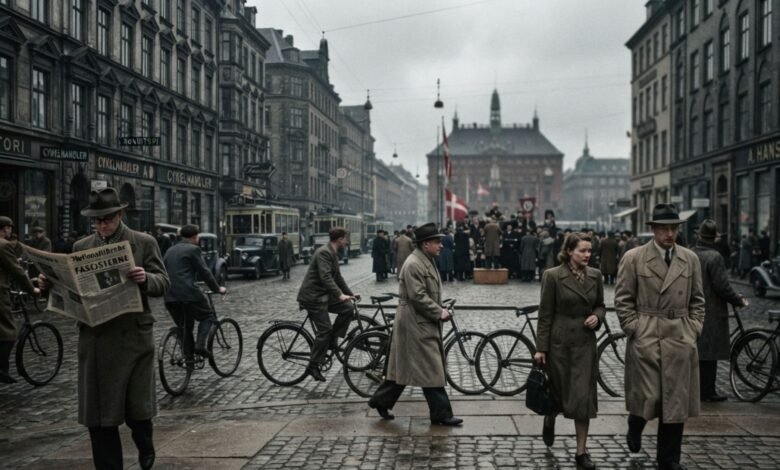
The word fascisterne can stop an English-speaking reader because it resembles the English word fascist while adding a distinctive Danish ending. That small linguistic difference matters: a mistranslation can turn an ordinary grammatical form into what appears to be the name of a specific organisation.
The historical stakes are larger still. The people described as fascists belonged, in different countries and periods, to political movements associated with authoritarian rule, intense nationalism, anti-democratic politics and political violence. Yet those movements were not identical, and the word must be read in context.
BLUF: Fascisterne is definitively the Danish definite plural of fascist, meaning “the fascists.” It does not, by itself, name a particular party or organisation. The exact group depends on context, which may involve Italian Fascists, Danish fascists or Nazis, or a broader modern political usage.
The Danish ending that changes “fascists” into “the fascists”
Den Danske Ordbog records fascist as a Danish noun meaning a supporter of fascism and gives its inflection as -en, -er, -erne. That produces the familiar sequence:
| Danish form | English sense |
|---|---|
| fascist | a fascist |
| fascisten | the fascist |
| fascister | fascists |
| fascisterne | the fascists |
The final -erne is therefore not part of the ideology’s name. It is a grammatical ending expressing the definite plural. Den Danske Ordbog’s entry explicitly lists fascisterne among the inflected forms.
That distinction is especially useful when translating Danish historical sources. A sentence using fascisterne may be referring to a group that has already been identified elsewhere in the text. The surrounding nouns, dates, country names and political context tell the reader which people are meant.
Fascisterne is not the Danish word for fascism
There are two related but different concepts:
- fascisterne = the fascists
- fascisme = fascism
The first identifies people. The second identifies a political ideology and movement. Confusing the two can make a historical translation sound more specific than the original Danish actually is.
The distinction also explains why fascisterne can appear in very different historical settings. A Danish historian writing about Italy may use the word for Mussolini’s followers. A historian writing about Denmark in the 1930s may use it for Danish fascists or Nazi activists. A modern political article may use the term more loosely, depending on the writer’s intended meaning. The grammar stays the same; the reference changes.
Fascism began as a political movement in post-war Italy
The word fascisterne ultimately leads back to a much larger European history.
According to Lex’s Danish historical reference, fascism was established as a political movement by Benito Mussolini in Milan on 23 March 1919, when the Fasci di combattimento were formed. The movement initially drew heavily on war veterans and presented itself through nationalism, anti-democratic politics, anti-socialism and political violence.
The Museum’s Holocaust Encyclopedia similarly traces the development of Italian Fascism to Mussolini in 1919 and identifies the March on Rome of 27–28 October 1922 as the decisive episode that brought Mussolini into government. Around 30,000 armed Fascists participated in the mobilisation. King Victor Emmanuel III ultimately invited Mussolini to form a government.
The episode matters because fascist movements did not simply win power through ordinary electoral competition. Political intimidation, paramilitary violence and pressure on democratic institutions were central to the Italian story. The subsequent dictatorship progressively dismantled parliamentary constraints.
Britannica describes fascism as a political ideology and mass movement that spread through parts of Europe between 1919 and 1945, while noting that national movements differed significantly even when they shared characteristics such as militaristic nationalism, hostility to electoral democracy and the subordination of individual interests to an all-encompassing national community.
What the word “fascist” actually describes
The historical definition cannot be reduced to “someone who is authoritarian”.
The United States Holocaust Memorial Museum describes fascism as an ultranationalist and authoritarian political philosophy that rejects pluralist democracy and places the nation above individual rights. Its characteristics can include political repression, paramilitarism, militarism, suppression of opponents and the concentration of political authority around an authoritarian leader.
That definition provides the context behind the Danish noun.
Five features repeatedly associated with historical fascist movements
| Feature | Historical meaning |
|---|---|
| Ultranationalism | The nation is treated as the highest political priority |
| Anti-democratic politics | Liberal and representative institutions are regarded as obstacles |
| Authoritarian leadership | Political authority is concentrated around a dominant leader |
| Suppression of opponents | Opposition parties, movements and critics can be targeted |
| Political violence and militarism | Force and paramilitary organisation become political tools |
These features occurred with different emphases in different countries. Fascism was not a single identical programme exported unchanged across Europe. Even where movements copied one another, national conditions influenced their organisation and political ambitions.
That is why a careful translation should avoid treating every use of fascisterne as though it refers to one homogeneous international organisation.
Denmark gave the word a particularly specific wartime meaning
The Danish context is where fascisterne becomes especially interesting.
Danmarks Nationalsocialistiske Arbejderparti (DNSAP) was founded on 16 November 1930, with Cay Lembcke as its first leader. According to Aarhus University historian Niels Wium Olesen’s Denmark history article, the party was strongly inspired by Adolf Hitler’s German NSDAP and copied its programme almost word for word. Its political language and imagery also drew heavily from the German model, including anti-parliamentarianism, antisemitism and aggressive nationalism.
The party later came under Frits Clausen, who replaced Lembcke as leader in 1933. Lex describes DNSAP as closely modelled on the German Nazi Party in its organisational structure, symbolism and ideological programme, including the leadership principle, antisemitism and racial doctrine.
This is an important distinction for anyone researching fascisterne in Danish history. A Danish source might use the word in relation to fascists generally, but wartime discussions may also specifically involve DNSAP, Danish Nazis, collaborators or other right-wing organisations. Those categories overlap historically in some cases, but they are not interchangeable labels.
DNSAP entered parliament—but never became Denmark’s ruling party
The electoral record shows just how limited the party’s parliamentary reach remained.
At the 1939 Danish parliamentary election, DNSAP received 31,032 votes, equivalent to 1.83% of the vote, and won three seats in the Folketing. The official election figures published through Lex identify the source as Statistics Denmark.
In the 1943 election, the party increased its vote to roughly 2.1%, or a little over 40,000 votes, while again winning three seats. Denmark’s historical reference describes DNSAP as a marginal force despite the favourable circumstances created by the German occupation.
A compact Danish fascist timeline
| Date | Event | Historical significance |
|---|---|---|
| 23 March 1919 | Mussolini’s Fasci di combattimento formed in Milan | The Italian fascist movement takes organised political form |
| 27–28 October 1922 | March on Rome | Mussolini is invited to form the Italian government |
| 16 November 1930 | DNSAP founded in Denmark | Danish National Socialism is formally organised |
| 1933 | Frits Clausen becomes DNSAP leader | Party leadership shifts to Clausen |
| 1939 | DNSAP wins 1.83% and three Folketing seats | First parliamentary representation |
| 9 April 1940 | Germany occupies Denmark | Danish fascists operate under a radically changed political environment |
| 1943 | DNSAP wins about 2.1% and three seats | Increased vote share still does not translate into power |
| 1945 | DNSAP dissolves | The party disappears after Denmark’s liberation |
The dates combine Italian fascist history from the Holocaust Encyclopedia and Lex with Danish political history from the Denmark-history reference and election data.
“Fascisterne” and “the Nazis” are related terms, but not perfect synonyms
One of the most common historical shortcuts is to assume that every fascist was automatically a Nazi.
The relationship is more precise than that.
The Holocaust Encyclopedia describes Nazi Germany under Adolf Hitler from 1933 to 1945 as a fascist government while also treating National Socialism as its own movement with distinctive racial and ideological characteristics.
Lex similarly treats Nazism as a variant of fascism, while distinguishing the German movement from Italian Fascism and other national forms.
That matters when translating Danish material from the Second World War. A text referring to fascisterne may discuss Fascists in the general ideological sense, while another passage may specifically mean DNSAP, German Nazis, or people cooperating with the German occupation.
Why context beats automatic translation
Consider three hypothetical Danish references:
fascisterne i Italien
“the fascists in Italy”
de danske fascister
“the Danish fascists”
nazisterne
“the Nazis”
The first two are built around fascist. The third uses a separate noun. A translator should preserve those distinctions rather than flattening every right-wing movement of the era into one category.
German occupation changed the meaning of political labels in Denmark
Germany invaded Denmark on 9 April 1940, breaking the non-aggression understanding Denmark had hoped would preserve its neutrality. The Danish government and police initially retained substantial domestic authority, while Germany directed foreign policy and other strategic matters.
For DNSAP, the occupation created an obvious political opportunity. The party expected German support to help bring it into government, but those expectations were not fulfilled. Denmark’s historical record notes that the German occupation authorities found greater utility in working with the existing parliamentary government.
That point is crucial because it shows why the existence of a fascist or Nazi party did not mean Denmark became a fascist state.
DNSAP existed. Its activists participated in politics. The party achieved parliamentary representation. But it remained electorally marginal and did not replace the Danish political system with a one-party dictatorship.
The Danish wartime record also included organised resistance
The history behind fascisterne is not only a story about extremist political movements. Denmark also became known for resistance to Nazi rule.
The Holocaust Encyclopedia records the German occupation beginning in April 1940 and explains that Danish resistance activity expanded significantly after 1943. Resistance actions included sabotage, attacks on occupation infrastructure and assistance to persecuted people.
The most famous episode concerns Denmark’s Jewish population.
In late September 1943, German plans to deport Danish Jews became known to Danish authorities and resistance networks. During the rescue operation that followed, Danish fishermen and others helped transport roughly 7,200 Jews to neutral Sweden, according to the Holocaust Encyclopedia.
The operation became one of the best-known rescue efforts in occupied Europe. The US Holocaust Memorial Museum records that approximately 7,200 of Denmark’s 7,800 Jews were transported to safety.
That wider history matters because the Danish word fascisterne sits inside a period marked by both collaboration and resistance. It should never be used as though the entire Danish population shared the ideology it describes.
How the word is used today is a different question
Modern political language often stretches historical terms.
Den Danske Ordbog records a secondary, transferred sense of fascist for a person displaying strongly right-wing and nationalist ideas or supporting authoritarian suppression of those who think differently.
That broader meaning helps explain why a contemporary Danish writer might use fascisterne outside a strict discussion of 1920s or 1930s fascist organisations.
But historical terminology and political rhetoric are not the same thing.
Calling a group fascisterne in a history book may identify an established fascist movement. Calling contemporary opponents fascisterne may be a political accusation whose accuracy depends on evidence and on the definition being applied. The dictionary itself recognises both the narrower and transferred senses.
That makes context essential for translation, journalism and search interpretation.
The real lesson behind “fascisterne” is precision
A single Danish ending can hide a substantial historical distinction.
Fascisterne does not mean “Fascism.” It means “the fascists.” It is a definite plural form of fascist, and the group it identifies must be established from context. In a historical source, that may mean Mussolini’s followers, Danish fascists, DNSAP activists or another movement classified as fascist.
The broader history explains why accuracy matters. Italian Fascism emerged after the First World War; Mussolini reached government in 1922; fascist ideas and organisations spread beyond Italy; Nazi Germany represented a distinct German form of fascist politics; and Denmark developed its own nationalist-Nazi movement through DNSAP between 1930 and 1945.
A translation that simply renders every use of fascisterne as “Nazis” would therefore lose information. A translation that treats it as the official name of a single organisation would introduce information that is not in the Danish word.
The correct reading is much simpler—and much more useful:
fascisterne = the fascists.
People Also Ask
What does fascisterne mean in English?
Fascisterne means “the fascists” in English. It is the definite plural form of the Danish noun fascist. The word identifies people described as fascists rather than naming fascism itself. The exact group depends on the context in which the Danish word appears.
Is fascisterne a political party?
Fascisterne is not, by itself, the name of a political party. It is an ordinary Danish grammatical form meaning “the fascists”. A Danish text could use it when discussing an organised party, historical movement or a broader group of people identified as fascist. Context determines the reference.
What is the singular form of fascisterne?
The singular indefinite form is fascist, while the singular definite form is fascisten. The plural indefinite is fascister, and the plural definite is fascisterne. Den Danske Ordbog gives the inflection as -en, -er, -erne.
Was there a fascist movement in Denmark?
Denmark had a major Nazi political organisation called Danmarks Nationalsocialistiske Arbejderparti, or DNSAP. It was founded on 16 November 1930, closely modelled on Germany’s NSDAP, and remained a marginal parliamentary force. It won 1.83% of the vote and three seats in 1939, then about 2.1% and three seats in 1943.
Is Nazism the same as fascism?
Nazism is generally treated by major reference sources as a German variant of fascism, but the two terms are not simply interchangeable. Nazi ideology developed distinctive racial, antisemitic and expansionist doctrines, while fascism also existed in other countries and took different national forms.
When did fascism begin?
Fascism emerged as an organised political movement in Italy in 1919 around Benito Mussolini. His Fasci di combattimento were formed in Milan on 23 March 1919, while the decisive seizure of political power came with the March on Rome in October 1922.
Where the Danish word ends, the historical record begins
fascisterne looks small on the page, but it carries a century of political history behind it.
Its grammar is straightforward. Its historical use is not.
The safest reading is therefore neither to exaggerate the word nor to strip it of context. Fascisterne means “the fascists,” while the identity of those fascists must be established from the surrounding text, date, country and political organisation.
That distinction is particularly important for Danish historical material, where Fascism, National Socialism, DNSAP, German occupation and resistance existed within the same complicated period.
Precision is not a cosmetic detail here. It is the difference between translating what a source says and silently rewriting it.
Editorial Disclaimer
This article distinguishes established historical and linguistic evidence from broader modern usage. Political terminology can change meaning according to context, and labels such as fascist, fascisterne and Nazi should not be treated as interchangeable without supporting evidence. No unverified personal, political or historical claim has been presented as established fact.
Read More On Global Nova