Blazertje Explained: The Dutch Fashion Word That Looks Like a New Trend
It sounds like a new fashion category, but one tiny Dutch ending changes the story completely.

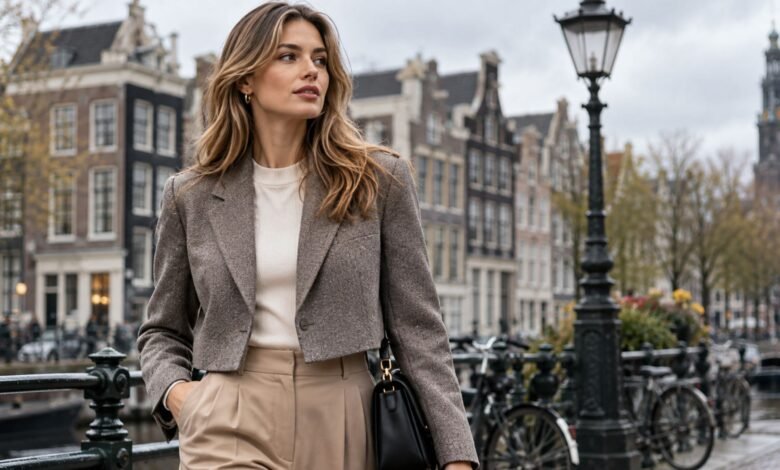
The word blazertje has recently become unusually visible in English-language fashion searches, where it is sometimes presented as though it were a defined new kind of jacket. That interpretation misses the most basic clue: blazertje is Dutch grammar applied to the word blazer.
That matters because the word can describe a genuinely small or cropped jacket, but it does not require one particular length, fabric, silhouette or level of tailoring. In Dutch, the ending -tje is a diminutive formation, and diminutives can convey more than literal physical size.
A look at actual Dutch retail language makes the distinction clearer. Current Zalando and Wehkamp pages use blazertje naturally alongside ordinary blazer terminology, including fitted, cropped and casual examples, rather than treating it as the name of one fixed garment category.
BLUF: Blazertje is the Dutch diminutive of blazer and literally means “little blazer” or “small blazer.” It is not a standardised fashion category with one required cut. Depending on context, it can imply smallness, softness, familiarity or informality, while the actual garment may be cropped, fitted, relaxed or conventionally tailored.
The five facts that settle the blazertje question
- Word: blazertje
- Language: Dutch
- Base word: blazer
- Grammatical form: diminutive noun
- Literal English sense: little blazer / small blazer
- Article: het blazertje
- Plural: blazertjes
- Fixed fashion category: No
- Possible real-world styles: cropped, fitted, relaxed, structured, lightweight or conventional blazer silhouettes, depending on context
There is another useful distinction. The Dutch word blazer itself is a loanword. The Etymologisch Woordenboek of the Instituut voor de Nederlandse Taal records Dutch blazer as a noun meaning a short jacket and dates its Dutch use to 1940, tracing it to English blazer.
So the linguistic chain is remarkably simple:
English blazer → Dutch blazer → Dutch diminutive blazertje
That is the core of the story.
The tiny “-tje” is doing most of the work
Dutch makes extensive use of diminutives. A noun can receive a diminutive ending to express smallness, but the result can also sound familiar, informal, affectionate or softer than the base form. The Taalunie’s grammatical material explicitly notes that Dutch diminutives are grammatically neuter, which is why het is used with them.
The ending can vary depending on the sound and structure of the base word. Dutch grammar references describe -tje as one of the standard diminutive endings.
For blazertje, the structure is:
| Element | Function |
|---|---|
| blazer | Base noun |
| -tje | Dutch diminutive ending |
| blazertje | Diminutive form |
| het blazertje | Grammatically neuter form |
| blazertjes | Plural |
This is why translating blazertje simply as “blazer” loses something. The base meaning survives, but the diminutive nuance disappears.
English tends to express the distinction separately: “little blazer”, “small blazer”, “cute blazer”, “casual blazer” or sometimes simply “blazer”. Dutch can build part of that nuance directly into the noun.
Does the word always mean physically small?
No.
This is one of the easiest mistakes to make when reading Dutch fashion language.
A diminutive can refer to literal size, but size is not the only possibility. Dutch diminutives can carry social or emotional nuance as well. A speaker may choose a diminutive because something feels familiar, informal, pleasant or less formal, rather than because it is dramatically smaller.
That means a Dutch speaker could refer to a blazer as blazertje even when an English speaker looking at the garment would not call it “tiny”.
The surrounding sentence is therefore more informative than the suffix alone.
Why blazertje is not the same thing as “cropped blazer”
The modern fashion interpretation creates a second layer of confusion.
In English-language fashion publishing during 2026, cropped jackets and shorter blazer silhouettes have received significant editorial attention. British Vogue reported a move towards cropped iterations that fit closer to the body, while Vogue’s Spring 2026 coverage highlighted “little jackets” and shorter structured silhouettes. Vogue Arabia likewise covered the cropped blazer as a transitional layer.
That fashion movement can make blazertje look like a perfect Dutch label for the trend.
But linguistically, the two concepts are not interchangeable.
A cropped blazer describes a recognisable silhouette: the garment is deliberately shorter.
A blazertje describes a diminutive grammatical form. It can refer to a smaller garment, but it does not establish a particular hemline.
That distinction is visible in Dutch-language retail results. Zalando currently uses blazertje for garments described as cropped or fitted, but the word appears across different styles rather than one standard construction.
The safest interpretation is therefore:
Every cropped blazertje can be a blazertje, but not every blazertje has to be cropped.
That is an editorial distinction worth preserving because it prevents a language question from being turned into an invented clothing taxonomy.
The blazer itself has a surprisingly British history
Understanding the base word makes blazertje even more interesting.
St John’s College, Cambridge, traces the word blazer to the bright red jackets associated with the Lady Margaret Boat Club, founded at St John’s in 1825. The College says the distinctive red jackets contributed to the origin of the term and identifies 22 August 1889 as the first recorded use of the word in the London Daily News.
A historical article preserved in the College’s Eagle archive provides even earlier documentary context. It reproduces an 1853 Cambridge University Almanack reference to a red “blazer” in the Lady Margaret Boat Club uniform and explains that the term was associated with the club’s bright red jackets.
The etymological evidence also connects the English clothing term with the idea of something bright or blazing. The Dutch Etymologisch Woordenboek explains the Dutch blazer as a borrowing from English and links the English term to blaze, referring to the conspicuous colours of the jackets.
A compact history of the word
| Period | Development | Significance |
|---|---|---|
| 1825 | Lady Margaret Boat Club founded at St John’s College, Cambridge | Begins the institutional history most closely associated with the blazer |
| 1850s | Cambridge records show “blazer” being used for the club jacket | Evidence that the clothing sense was already established |
| 1889 | London Daily News records “blazer” in wider usage | Marks an important documented stage in the word’s spread |
| 1940 | Dutch blazer attested in Koenen | Establishes the Dutch loanword in the modern lexical record |
| 2026 | Cropped and shorter jacket silhouettes receive renewed fashion attention | Helps explain why blazertje can look like a new style term online |
This history also shows why the word carries a subtle cultural contradiction. The blazer began with vivid sporting identity and institutional affiliation; blazertje, by contrast, sounds deliberately smaller and more informal.
The modern Dutch shopping page is where the meaning becomes practical
A dictionary gives you the grammar. Retail language shows how people actually use it.
On Dutch-language shopping platforms today, blazertje appears naturally inside descriptions of garments that would still be recognisable to an English speaker as blazers. Zalando search results include a grey textured “blazertje”, a cropped black blazertje, and a burgundy corduroy blazertje.
Wehkamp provides another useful example. A customer review of a girls’ blazer describes it as a “top blazertje”, demonstrating an informal use of the diminutive rather than a technical product classification.
There are also examples where fashion retailers use blazertje in general outfit advice. Wehkamp describes an elegant short blazertje as an optional layer for a wedding guest outfit, while its broader jacket copy uses the word for versatile styling rather than one fixed construction.
That is important evidence because it moves the discussion away from English-language articles talking about the word and towards actual Dutch commercial usage.
What should a shopper look for instead of relying on the word?
When a listing says blazertje, inspect the actual garment specifications:
| What to check | Why it matters |
|---|---|
| Length | Tells you whether it is cropped, regular or longline |
| Fit | Distinguishes fitted, straight and oversized shapes |
| Fabric | Indicates structure, breathability and seasonality |
| Shoulder construction | Helps distinguish soft tailoring from stronger tailoring |
| Lining | Signals how formal or substantial the garment is |
| Closure | One-button and double-breasted styles create different proportions |
| Pocket design | Helps identify traditional tailoring versus casual construction |
| Stretch content | Indicates how closely the garment is designed to move with the body |
The name blazertje alone cannot answer these questions.
That is perhaps the most practical lesson for international shoppers.
What a blazertje can look like in 2026
Here the word intersects with real fashion trends without becoming synonymous with them.
British Vogue highlighted the shift from oversized blazers towards shorter, closer-fitting jacket shapes in 2026, while Vogue’s wider Spring 2026 coverage emphasised “little jackets” as a prominent outerwear direction.
Who What Wear UK’s 2026 blazer coverage also identifies several distinct directions, including collarless designs, funnel-neck blazers, belted tailoring, longline blazer dresses and shoulder-padded jackets.
This matters because it demonstrates how broad the modern blazer category already is.
A blazertje can therefore sit comfortably inside several contemporary wardrobes:
A cropped version: Shorter through the torso, often styled with high-waisted trousers, jeans or skirts.
A fitted version: Closer at the waist and shoulders, useful where the wearer wants conventional tailoring without a long silhouette.
A soft version: Less rigid construction, often suitable for travel, smart-casual dressing or warmer weather.
A formal-looking version: Structured shoulders, sharper lapels and traditional suiting fabric.
A relaxed version: Looser proportions, lighter construction and deliberately informal styling.
Nothing about the Dutch diminutive prevents any of these.
That is why calling blazertje a single “new fashion trend” is unnecessarily restrictive.
The word also explains a broader feature of Dutch fashion language
The attraction of blazertje is not really that Dutch has invented a better blazer.
It is that Dutch can make an ordinary noun feel more specific without creating a completely new word.
The Taalunie’s grammatical material gives the broader principle: diminutives are a normal feature of Dutch and are not limited to objects that are physically tiny.
That is why similar forms appear throughout everyday language. The diminutive can reduce physical scale, soften tone, create familiarity, or add an informal register.
For someone learning Dutch, blazertje is therefore useful as a miniature grammar lesson:
blazer tells you what the object is.
-tje tells you something about how the speaker is framing it.
The remaining meaning has to come from context.
Is blazertje childish or informal?
Not necessarily.
A diminutive can sound informal, but that does not make it incorrect or childish. Diminutives are a normal grammatical feature of Dutch, including ordinary written and spoken usage.
In fashion copy, the choice can actually make the description sound more approachable.
Compare the emotional register:
- blazer — neutral
- blazertje — more intimate, casual or diminutive
- cropped blazer — technically descriptive
- tailored blazer — structurally descriptive
These phrases can overlap, but they are not interchangeable.
Why English-language search results can make the term look more mysterious than it is
There is now a noticeable body of English-language content explaining blazertje, and many pages frame it as a new fashion term. That presentation creates an odd feedback loop.
A person searches blazertje.
They find articles describing a supposedly emerging style.
They see examples of cropped, soft or relaxed jackets.
They assume blazertje must therefore be the Dutch name for that exact silhouette.
Then the next article repeats the same interpretation.
The original linguistic distinction gets weaker with every repetition.
The evidence from Dutch grammar, official spelling resources and real retail usage points to a more grounded explanation: the word itself is established as a diminutive, while the specific fashion characteristics depend on the garment and context.
That distinction is particularly useful in 2026 because shortened tailoring genuinely is receiving fashion coverage. The trend is real; the assumption that blazertje is its official technical name is a separate claim.
Global Nova’s profile of Sophia Law likewise provides a related example of how modelling and fashion references can shape the public description of a celebrity family member without necessarily defining an established career category. Sophia Law profile on Global Nova
Five ways to interpret blazertje without getting caught by translation
When it appears in a dictionary context:
Read it as the diminutive of blazer.
When it appears in a Dutch conversation:
Expect additional nuance such as smallness, familiarity or informality.
When it appears on a clothing retailer:
Ignore the name until you inspect length, fabric and construction.
When it appears in English fashion media:
Check whether the writer is using it as a translation, a Dutch-language reference or an informal label for a specific silhouette.
When it appears beside words such as “cropped”, “waisted” or “oversized”:
Those additional descriptors provide the actual garment information. Blazertje itself does not settle the silhouette.
Frequently Asked Questions About Blazertje
What does blazertje mean?
Blazertje is the Dutch diminutive form of blazer, meaning “little blazer” or “small blazer.” The suffix -tje is a standard Dutch diminutive ending. Depending on context, the word may indicate literal size or simply create a softer, more familiar or informal tone.
Is blazertje a real Dutch word?
Yes, blazertje is a legitimate Dutch diminutive form of blazer. The official Dutch spelling system recognises diminutive forms as part of the language, while Dutch lexical references list blazertje as the diminutive and blazertjes as the plural.
Is a blazertje the same as a cropped blazer?
Not exactly. A cropped blazer is defined by its shorter silhouette, whereas blazertje is primarily a grammatical diminutive. A blazertje can be cropped, but it can also be fitted, relaxed, structured or otherwise styled depending on the particular garment.
What article do you use with blazertje in Dutch?
The correct article is het. Dutch diminutive nouns are grammatically neuter, regardless of the gender of the base noun. Therefore, de blazer becomes het blazertje.
What is the plural of blazertje?
The plural is blazertjes. The base form blazer has the plural blazers, while the diminutive follows the regular plural pattern for the diminutive form: blazertje → blazertjes.
Why are people talking about blazertje in fashion?
The word is receiving more attention because shorter and more compact blazer silhouettes are prominent in 2026 fashion coverage. British Vogue, Vogue and other fashion publications have highlighted cropped or “little” jackets, creating an easy association with the Dutch diminutive even though the terms are not technically identical.
Is blazertje a brand or a fashion label?
No, blazertje is a Dutch noun rather than a brand name. Its structure is simply blazer plus the diminutive suffix -tje. Individual retailers may use it in product descriptions, but the word itself does not identify a company, designer or proprietary clothing line.
The real story behind the little word
Blazertje looks complicated because English readers encounter a familiar clothing word wearing an unfamiliar Dutch ending.
Take away the spelling surprise and the structure becomes straightforward.
Blazer is the borrowed clothing noun.
-tje is the diminutive.
Blazertje is therefore the Dutch diminutive of blazer.
The interesting part is what that diminutive does not tell you. It does not fix the hemline, dictate the fabric, establish a formal dress code or guarantee that the jacket is dramatically smaller. Those details belong to the actual garment and the surrounding language.
The modern fashion world happens to be making the word more visually tempting than ever. Cropped blazers, little jackets, waisted tailoring and softer proportions are receiving substantial attention in 2026. But a fashion silhouette and a grammatical diminutive remain two different things.
That is what makes blazertje more than a translation curiosity. It is a small example of how language can shape the way clothes are perceived—sometimes with a single suffix doing the work that an entire English phrase would need to explain.
Editorial Disclaimer: This article separates documented Dutch linguistic usage from newer fashion-media interpretations. Where blazertje is used informally by retailers or English-language publishers, the precise intended nuance depends on context. Fashion terminology can vary between brands, markets and languages, so individual product descriptions should be checked rather than inferred from the word alone.