ABS Testauslösung Explained: What the Avalanche Airbag Test Really Does
The phrase sounds technical, but the test itself answers a surprisingly simple question: will the avalanche airbag trigger when you need it?

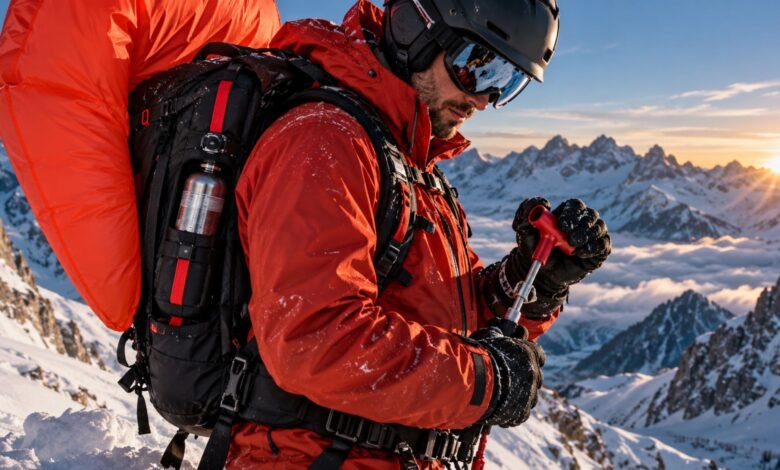
Search interest around “ABS Testauslösung” can be confusing because “ABS” also means an automobile’s anti-lock braking system. In the context of ABS Sports + Protection, however, the phrase refers to the controlled training activation of an ABS avalanche airbag. That distinction matters because the correct testing routine, equipment, servicing and safety precautions are completely different.
For backcountry skiers and snowboarders, an avalanche airbag is not ordinary luggage. It is emergency equipment designed to reduce the likelihood of critical burial during an avalanche. The Wilderness Medical Society’s 2024 avalanche guidelines describe avalanche airbags as devices intended to reduce burial through increased effective volume, while stressing that non-deployment, trauma, deep burial and other hazards remain possible.
BLUF: For the ABS avalanche-airbag system, ABS Testauslösung is a controlled training activation used to check deployment and practise pulling the release handle. ABS recommends a training deployment before every season and a manufacturer general check at three-year intervals; the exact reset or refill process depends on the ABS system and cartridge type.
Quick Snapshot: What “ABS Testauslösung” Actually Means
- Primary meaning: Test or training deployment of an ABS avalanche airbag.
- ABS in this context: The avalanche-airbag brand, not a vehicle Anti-lock Braking System.
- Main purpose: Check basic system function and practise the physical movement required to deploy the bag.
- Manufacturer guidance: ABS recommends a training deployment with a filled cartridge before every season.
- General service interval: ABS recommends a manufacturer general check every three years.
- Main technologies: ABS EasyTech, ABS Solid and electronic Alpride E2 systems appear within the current ABS technology family.
- Core limitation: An airbag does not make avalanche terrain safe and cannot guarantee survival. (ABS)
The Most Important Meaning of the Keyword Is Not Automotive
The phrase Testauslösung literally carries the idea of a test activation or test deployment. Search engines can mix two very different uses of “ABS”: automotive anti-lock braking and avalanche airbags.
The manufacturer’s own German-language documentation resolves the ambiguity for its products. ABS uses Testauslösung when discussing the controlled triggering of its avalanche-airbag systems. Its FAQ explicitly recommends a training deployment before every season, while its service pages describe complete system checks that include test activation and functional or leak testing.
That makes the safest interpretation of the exact keyword clear:
ABS Testauslösung = test activation of an ABS avalanche-airbag system.
An automotive ABS self-test is a different subject entirely. Some vehicle manufacturers use “self-test” for an automatic check performed shortly after startup or when the car begins moving. That is not what the ABS avalanche-airbag manufacturer means by Testauslösung.
Why a Training Trigger Matters Before Winter Starts
An avalanche-airbag can only help if the user can deploy it correctly and the system is ready to operate.
ABS states that the annual training activation serves two purposes: checking the system and practising the hand movement required to pull the release handle. The manufacturer specifically says that this movement should become reflexive so the user can react quickly during an emergency.
That point is backed by independent avalanche medicine research. The 2024 Wilderness Medical Society guidelines identify operator error as the most important limitation of avalanche airbags, with a substantial proportion of non-inflations attributed to the user failing to trigger the device. A separate review of real-world avalanche data found non-inflation to be a major limitation, including failures related to user deployment, maintenance and equipment problems.
So the training deployment is not merely a mechanical ritual. It familiarises the user with the exact physical action that has to happen under stress.
What Happens During an ABS Testauslösung?
The answer depends on the specific ABS system.
Current ABS documentation describes three release technologies: Alpride E2, EasyTech and Solid. The operating principles differ, although their purpose is the same: activate the avalanche-airbag inflation system. (ABS)
ABS EasyTech uses a mechanical release
ABS describes EasyTech as a mechanical activation system. Pulling the handle releases a preloaded spring through a Bowden cable, which drives the mechanism that punctures the cartridge.
ABS says the cartridge contains gas under high pressure and that the resulting gas flow fills its TwinBags in approximately 3–4 seconds. The manufacturer also says EasyTech allows repeated practice deployments without consuming a cartridge, because the test function can be operated without actually using a cartridge.
ABS Solid uses a pyrotechnic release mechanism
The Solid system is different. ABS states that pulling the handle initiates a pyrotechnic mechanism that creates the pressure needed to activate the cartridge. The released gas then travels into the airbag system and contributes to rapid inflation.
Because this mechanism consumes the relevant deployment components, the post-test service requirement differs from EasyTech. ABS says used cartridges and release handles are handled through manufacturer-controlled refill or replacement processes.
Alpride E2 is electronic
The Alpride E2 platform uses an electronic blower system rather than a compressed-gas cartridge as its inflation method. ABS says the system performs a self-test whenever it is switched on and uses a supercapacitor-based power system. It also supports repeated activation practice without replacing a gas cartridge.
That distinction is important when someone searches for “ABS Testauslösung” and assumes every ABS backpack follows exactly the same procedure.
The Three-System Comparison
| ABS system | Activation principle | Cartridge required for every practice trigger? | Key manufacturer point |
|---|---|---|---|
| EasyTech | Mechanical spring/Bowden-cable mechanism | No, for its cartridge-free practice function | Designed for repeated practice and tool-free activation |
| Solid | Pyrotechnic activation of the cartridge | Yes for an actual cartridge deployment | Used cartridge/handle require the correct refill or replacement process |
| Alpride E2 | Electronic blower with supercapacitor | No gas cartridge required for activation | Performs an automatic self-test when switched on |
ABS identifies these three systems in its current technology documentation. The exact procedure should always follow the manual for the individual backpack and release system.
ABS Testauslösung: The Manufacturer’s Recommended Rhythm
ABS’s current FAQ gives a straightforward maintenance pattern.
Before every season: perform a training deployment.
Every three years: send the equipment for the manufacturer’s recommended general check.
After an avalanche deployment: have the system checked, because an avalanche can expose the backpack, airbag material, straps, valves, tubing and other components to unusual loads. ABS recommends a more comprehensive inspection after an avalanche or after approximately three to five seasons depending on use.
This creates an important distinction between self-checking and manufacturer servicing. A successful Testauslösung does not mean that the complete backpack has passed every engineering and condition check.
The annual check is about readiness
A successful training deployment tells the user something useful: the system can be activated in the intended training configuration and the deployment action has been practised.
It does not prove that every component is still within its service life, that every seam is perfect, or that the pack has not suffered hidden damage.
The general service checks much more
ABS says its complete service includes inspection of backpack straps, buckles, airbag pockets, Velcro fasteners, the piercing unit, hoses and cables. It can also include inspection of the airbag wings, release valve, inflation system and material tightness.
That is why a yearly deployment and a three-year service should not be treated as interchangeable tasks.
The Cartridge Is a Safety Component, Not a Generic Gas Bottle
One of the easiest mistakes is assuming an ABS cartridge can simply be refilled or substituted like an ordinary compressed-gas container.
ABS explicitly says its cartridges are designed for its own filling system and should not be used with other avalanche-airbag systems. The company also states that refilling is controlled by ABS rather than performed by general gas suppliers.
ABS’s current FAQ also specifies cartridge life information. The manufacturer states that steel cartridges generally expire after 10 years, while carbon cartridges generally expire after 15 years, with the applicable date indicated on the cartridge. It also gives a three-year life period for the release handle.
What should be checked before use?
ABS recommends regular cartridge inspection and says the cartridge can be weighed without its protective cap to verify its condition against the stated reference weight. The manufacturer advises against using a cartridge when its measured weight differs by more than 5 grams from the specified value.
That is unusually specific guidance, which is why generic “just look at the bottle” advice is inadequate for this equipment.
The Airbag Works by Changing the Physics of Burial
The reason an avalanche airbag exists is not simply that an inflated balloon is “stronger” than snow.
Avalanche snow behaves as a moving granular material. Research and clinical guidance describe the principle behind avalanche airbags as an increase in the user’s effective volume, which can reduce the likelihood of critical burial by taking advantage of granular convection or size segregation in flowing snow.
ABS describes the same core mechanism in its technical material, explaining that larger-volume objects are preferentially moved upward during granular flow and that additional surface area can help counter deep burial. The company’s TwinBag design uses two separate airbag chambers.
ABS lists a combined TwinBag surface area of 7,240 cm² in its technology documentation. That is a manufacturer specification rather than an independent industry-wide measurement.
The broader evidence is encouraging but not absolute. One major study found that correctly inflated avalanche airbags were associated with lower critical-burial risk than non-inflated devices, while the authors also identified non-deployment as a major limitation.
The Test Cannot Prove That an Avalanche Is Safe
This is where online explanations often become too casual.
ABS itself says its product does not prevent an avalanche or change the underlying risks of an avalanche and that life-threatening danger remains even with an airbag.
Independent medical guidance reaches a similar practical point. Avalanche airbags can reduce the likelihood of critical burial, but they do not eliminate deaths from trauma, cliff falls, trees, deep burial, secondary avalanche activity, airbag destruction or failure to deploy.
An airbag should therefore be treated as one layer of a broader avalanche-safety system, not as permission to enter unstable terrain.
ABS itself recommends using an avalanche transceiver, shovel and probe alongside the airbag because the functions are different: the airbag is intended to reduce burial, while the transceiver is used to locate a buried person.
ABS Testauslösung Safety Checklist
Before a training activation, the important issue is not speed. It is controlled, model-specific preparation.
- Use the manufacturer’s instructions for the exact ABS system.
- Confirm that the cartridge and release components are appropriate for that system.
- Never experiment with non-approved cartridges or components.
- Do not improvise with the release mechanism.
- Keep the environment clear and follow the manufacturer’s deployment instructions.
- After a cartridge-based deployment, restore the system using the correct ABS refill or replacement process.
- Treat any damaged, contaminated or questionable component as a service issue rather than attempting an improvised repair.
ABS’s FAQ is particularly explicit about the release handle. The company warns users not to attempt certain mechanical interventions themselves and advises sending problematic components to customer service when the mechanism does not operate correctly.
Current ABS Service Costs: What the Official Shop Lists
Prices can change, but the ABS online shop currently lists several relevant services.
| Service | Current listed price | What it covers |
|---|---|---|
| Service Large | €79 | Complete system check including test activation and functional/leak testing |
| Service Large & Refill | €119 | Complete system check plus cartridge/refill service |
| Service Large & Carbon Upgrade | €188 | Complete system check plus replacement/upgrade to a carbon cartridge |
| Refill Carbon | €49 | Refill service after an eligible test deployment |
These are the prices shown on ABS’s current official pages and may change with system, cartridge age, region or future shop updates.
The manufacturer also notes that cartridges older than 10 years fall under a special replacement pathway rather than ordinary refill arrangements.
A Timeline From Avalanche-Airbag Origins to Modern Test Systems
1970s — The underlying idea emerges
ABS’s company history attributes the early avalanche-airbag concept to observations involving large-volume objects remaining near the surface of moving snow.
1980 — Peter Aschauer acquires the patent
According to ABS’s own history, Peter Aschauer acquired the patent and established the company that developed the commercial ABS system.
1985 — The first fully functioning ABS avalanche airbag is presented
ABS records 1985 as the year its first fully functioning avalanche airbag was presented at ISPO. (ABS)
1996 — TwinBags arrive
ABS introduced its first system with two airbags, establishing the TwinBag architecture that remains central to the brand’s product identity.
2009 — Wireless partner activation
ABS introduced a radio-controlled partner-release concept through its Wireless Activation system, expanding the idea of who could initiate an airbag deployment.
2022 — EasyTech enters the range
ABS announced the EasyTech mechanical release system for the 2022–23 winter season, emphasising simple handling and straightforward practice deployment.
2026 — Testauslösung remains part of routine readiness
Current ABS documentation still recommends seasonal training deployment and periodic manufacturer inspection, while its service catalogue continues to offer system checks that include test activation.
What EN 16716 Adds to the Picture
The phrase “test activation” can sound like a brand-specific marketing term, but avalanche-airbag systems are also subject to formal safety requirements.
ABS’s safety-standards page identifies EN 16716 as the relevant European standard framework for avalanche-airbag systems and describes requirements covering activation, inflation, temperature performance, pressure testing, impact resistance, harness performance and other characteristics. ABS also notes that the standard is undergoing revision and that some requirements and values may be updated.
Among the requirements described by ABS are cold-temperature testing down to −30°C, activation and inflation performance, pressure testing and impact testing of the inflated system.
That matters because a successful backyard deployment is only one part of the larger engineering picture. Certification and service testing address conditions and failure modes that an individual user cannot reproduce at home.
The Search Confusion Around “ABS Testauslösung”
The German phrase is particularly vulnerable to search-intent mixing because ABS is overloaded as a technical abbreviation.
| Search context | Likely meaning |
|---|---|
| ABS Testauslösung + Lawinenairbag | Avalanche-airbag test activation |
| ABS Testauslösung + Kartusche | Airbag cartridge deployment/testing |
| ABS Testauslösung + EasyTech | ABS avalanche-airbag release system |
| ABS Testauslösung + Solid | ABS Solid avalanche-airbag system |
| ABS Testauslösung + Bremsen | Automotive ABS testing |
| ABS Testauslösung + Steuergerät | Vehicle diagnostic ABS system |
The official ABS avalanche-airbag documentation strongly supports the first four interpretations. Automotive documentation can produce the latter two, which is why the surrounding words matter when interpreting the keyword.
Related Reading From the Provided Site Network
A related article selected from the supplied site network is Jipinfeiche Explained, which examines the Chinese naming of the Need for Speed racing franchise and its connection with car culture and racing technology.
Jipinfeiche Explained: The Chinese Name Behind Need for Speed — Global Nova
People Also Ask About ABS Testauslösung
What is ABS Testauslösung?
ABS Testauslösung is a controlled test or training deployment of an ABS avalanche airbag system. ABS recommends carrying out a training deployment before each season to verify system function and practise pulling the release handle. The phrase refers to the avalanche-airbag brand in this context, not automatically to a vehicle anti-lock braking system.
How often should an ABS avalanche airbag be test triggered?
An ABS avalanche airbag should be training-triggered before every season, according to the manufacturer’s current guidance. ABS also recommends sending the system for a general manufacturer check every three years. After actual avalanche deployment or heavy use, ABS recommends a more comprehensive system inspection.
Does an ABS Testauslösung use up the cartridge?
It depends on the ABS system. A cartridge-based deployment can consume the cartridge and require refill or replacement, while ABS says EasyTech supports repeated practice without consuming a cartridge in its cartridge-free test mode. The Alpride E2 electronic system also permits repeated activation practice without a gas cartridge.
Does a successful Testauslösung prove the airbag is safe?
No. A successful test activation does not certify the entire avalanche-airbag system. It checks important aspects of deployment and gives the user practice, but ABS separately recommends periodic manufacturer servicing that examines straps, buckles, airbag compartments, hoses, valves, cables and other components.
How long do ABS cartridges last?
ABS says steel cartridges generally have a 10-year service life and carbon cartridges generally have a 15-year service life. The manufacturer states that the relevant expiry information is marked on the cartridge. It also says the release handle has a three-year validity period. These dates are product-specific and should be checked on the actual equipment.
Can an ABS avalanche airbag replace an avalanche transceiver?
No. An avalanche airbag and an avalanche transceiver perform different jobs. The airbag is designed to reduce the likelihood of critical burial, while a transceiver helps rescuers locate a buried person. ABS itself recommends carrying an airbag alongside a transceiver, shovel and probe rather than treating any one device as a substitute for the others.
The Trigger Is Small; the Stakes Are Not
ABS Testauslösung is ultimately about readiness rather than spectacle.
The test creates a controlled opportunity to verify deployment, understand the equipment and practise the hand movement that may become critical in an avalanche. ABS’s current documentation places that training within a broader maintenance cycle that includes seasonal checks, cartridge control and periodic professional servicing.
The wider evidence adds an equally important qualification: an avalanche airbag can reduce burial risk when it deploys correctly, but it does not remove avalanche danger. The Wilderness Medical Society continues to emphasise immediate escape attempts, rescue preparedness and the limitations of airbag systems.
For someone searching “ABS Testauslösung,” the clearest answer is therefore simple: it is the test activation of an avalanche-airbag system, and its real value lies in confirming readiness before the first serious day in avalanche terrain.
Editorial Disclaimer
This article distinguishes between manufacturer documentation, independent medical research and broader search interpretation. ABS service prices, product specifications, manuals and maintenance requirements can change, and procedures may differ between models. Always follow the current instructions supplied with the specific ABS system and use qualified manufacturer or authorised service support for equipment that is damaged, expired or malfunctioning.