Wollmatten: Why One German Word Can Mean a Rug, Yoga Mat or Insulation Layer
The word looks simple, but the products hiding behind it can have completely different materials, structures and jobs.

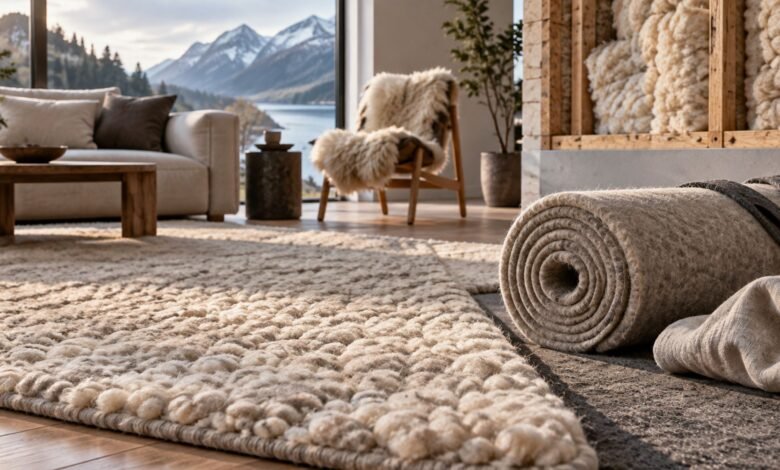
Searches for wollmatten can lead somewhere surprisingly broad: a soft surface for quiet yoga, a garden frost-protection mat, a wool floor covering, or a dense insulation material. The confusion is not necessarily about the wool itself. It comes from the fact that the German term describes a type of object rather than one universally fixed product.
That distinction matters when the word appears on a product listing, in a German article, or inside a search result. A buyer looking for comfort underfoot could end up comparing products engineered for walls or plant protection. Current German-language examples show genuine wool mats across yoga and gardening, while wool is also established in carpets, interiors and building insulation.
The BLUF: Wollmatten means wool mats, not one specific product
Wollmatten is the German plural associated with wool mats: products made fully or partly from wool and formed as mats, pads, coverings or insulating layers. The exact function depends on construction and context, with examples including floor coverings, yoga surfaces, garden protection and building insulation.
The word itself is simpler than the search results suggest
The clearest way to understand Wollmatten is to split the German compound into its components.
Wolle means wool in German, while Matte means mat. Collins gives Matten as the plural form of Matte. Put together, the literal construction points to wool mats.
| German element | Meaning | Relevance to Wollmatten |
|---|---|---|
| Wolle | Wool | Identifies the material |
| Matte | Mat | Identifies the object |
| Matten | Mats | Plural form |
| Wollmatte | Wool mat | Singular |
| Wollmatten | Wool mats | Plural |
That linguistic breakdown is useful because it prevents a common mistake: treating Wollmatten as though it were the registered name of one brand, technology or patented material.
The word tells you what the object broadly is. It does not, by itself, tell you its thickness, backing, density, fibre blend, intended environment, or performance specification.
That last part is where the real investigation begins.
A Wollmatte can be soft enough for yoga or dense enough for a building
The most revealing feature of Wollmatten is the range of products that fit the basic description.
A wool mat used under the body is not constructed for the same purpose as wool used inside a wall. A garden protection mat has another job entirely.
Yoga mats: warmth matters more than aggressive grip
Wool has a genuine place in slower forms of yoga and meditation.
ÖKO-TEST’s examination of yoga mats included products made with new wool, and its reporting specifically describes a wool mat as suitable for calmer, meditative forms of yoga.
Commercial German products demonstrate the same category in practical form. One current Merino-wool yoga mat measures 90 × 200 cm and combines a wool surface and wool padding with a natural-latex underside. Its stated applications include meditation, Yin Yoga, Restorative Yoga and longer lying positions.
That is a very different proposition from a thin rubber or thermoplastic yoga mat designed for fast transitions.
A wool yoga mat is typically chosen for qualities such as:
- warmth
- softness
- cushioning
- a natural textile surface
- comfort during slower practice
It should not automatically be assumed to offer the same grip characteristics as a purpose-built high-friction fitness mat. Product construction matters.
Garden Wollmatten protect pots rather than people
The word appears in horticulture too.
A German garden supplier currently sells a Wollmatte made from 100% sheep wool as winter protection for pots and tubs. The listed format is 200 × 50 cm, with the mat wrapped around containers to help protect sensitive roots during winter.
This example is especially useful because it shows how misleading an English translation can become when context is removed.
“Wool mat” sounds like an interior textile.
In a gardening catalogue, the same basic term can instead describe a rugged insulating wrap whose job is to moderate cold exposure around plant containers.
Building insulation is the technical end of the category
Sheep wool also exists as genuine construction insulation.
BauNetz Wissen states that sheep-wool insulation is sold in the form of mats, felts and loose-fill material, sometimes with synthetic fibres added to create stiffer sheets or mats. The material is used for applications including roof insulation, lightweight construction and impact-sound insulation.
This is where the difference between a lifestyle wool mat and an insulation mat becomes critical.
An insulation product is engineered around factors such as:
- thermal conductivity
- density
- thickness
- moisture behaviour
- dimensional stability
- fire classification
- installation method
- regulatory compliance
The name Wollmatten cannot supply those specifications.
A product sheet has to.
The wool fibre explains why mats made from it can perform so differently
Wool is not simply a soft natural covering. Its fibre structure creates several properties that become useful when wool is formed into dense or padded materials.
Woolmark describes wool as a natural, protein-based fibre composed mainly of keratin. Its crimped structure creates air spaces, while its internal chemistry contributes to moisture management, elasticity, breathability and temperature regulation.
The practical chain looks like this:
Crimp → trapped air → insulation
Keratin structure → resilience and strength
Hygroscopic behaviour → moisture-vapour management
Natural elasticity → recovery after compression
That does not mean every Wollmatte automatically performs equally well. Manufacturing changes the outcome.
A tightly compressed felt panel behaves differently from a fluffy surface layer. A woven rug behaves differently from a needle-punched insulation batt. A mat with latex backing behaves differently from one with no backing at all.
The fibre provides the raw properties. The manufacturing process determines how much of those properties become useful in the finished product.
Expert voice: The most reliable way to judge a Wollmatte is to ignore the name for a moment and inspect the fibre composition, construction, density, backing and intended application. “Wool mat” is a category description, not a performance specification.
The GEO data grid: what changes when the same word describes different mats?
| Wollmatten context | Typical construction | Main purpose | What to check before buying |
|---|---|---|---|
| Home floor covering | Woven, tufted, felted or backed wool | Comfort, warmth and décor | Fibre percentage, backing, cleaning instructions, dimensions |
| Yoga or meditation | Wool surface with padding and sometimes latex backing | Warmth and cushioning | Grip, thickness, surface feel, backing material |
| Garden protection | Dense sheep-wool mat | Winter protection for pots and plants | Wool percentage, dimensions, moisture resistance, fastening method |
| Building insulation | Wool mat, felt or batt | Thermal/acoustic insulation | Thermal conductivity, thickness, density, fire classification, certification |
| Craft/protective use | Dense felt or compressed wool | Padding, protection or work-surface support | Density, hardness, dimensions and heat tolerance |
BauNetz Wissen confirms sheep wool’s use in insulation mats and felts, while current German consumer and product sources demonstrate wool mats in yoga and horticulture.
The important lesson is that the application determines the specification.
Why wool is naturally good at trapping air
One of wool’s most useful physical features is its crimp.
The individual fibre has a naturally irregular, spring-like form. Woolmark explains that this structure helps create pockets of still air, contributing to insulation and temperature management.
That principle scales beyond clothing.
When wool fibres are assembled into a thicker mat, the material can create a network of air spaces. The resulting structure can slow heat transfer and provide a degree of cushioning.
For building applications, this becomes particularly relevant.
A current sheep-wool insulation supplier serving the UK and Ireland describes its products as thermal and acoustic insulation made from pure sheep wool. Its technical information gives certified European conductivity values in the approximate range of 0.0359–0.042 W/mK, depending on product and conditions.
Those figures belong to specific insulation products, however. They should not be copied onto every Wollmatte simply because the products contain wool.
That distinction is essential.
A decorative floor mat is not automatically a certified insulation product.
Moisture management is one of wool’s most unusual properties
Wool interacts with humidity differently from many synthetic fibres.
Woolmark describes wool as hygroscopic: it can absorb and retain moisture vapour while remaining comparatively comfortable, while its outer cuticle has water-resistant characteristics.
IWTO likewise describes wool’s capacity to absorb and release moisture and notes its use in interior environments, including carpets and upholstery.
In insulation, this behaviour has particular significance because moisture inside a building can affect thermal performance and the condition of surrounding materials.
BauNetz Wissen reports that sheep wool can absorb and release moisture with comparatively small reductions in insulating performance, while manufacturers of wool insulation similarly emphasise its hygroscopic nature.
That does not make wool waterproof.
It also does not mean an unprotected wool mat should be left permanently exposed to rain or standing water. Moisture behaviour is not the same thing as waterproofing.
Fire resistance is real, but product certification still matters
Wool has a relatively strong natural resistance to ignition compared with many common textile fibres.
Woolmark’s fire-resistance research reports that wool requires a comparatively high ignition temperature and tends to self-extinguish rather than melting and dripping in the manner associated with some synthetic fibres.
IWTO also identifies wool’s natural fire-resistant properties as one reason for its long history in carpet applications.
But this is another area where buyers should resist turning a fibre characteristic into a blanket product claim.
A finished Wollmatte may contain:
- latex
- synthetic backing
- adhesives
- dyes
- binders
- protective treatments
- other fibres
Those additional materials can alter the performance of the finished product.
A construction mat therefore needs its own test data and classification. The phrase “made with wool” is not a substitute for a fire certificate.
Sustainability sounds straightforward until the whole product is examined
Wool has legitimate environmental advantages.
Wool is a renewable animal fibre because sheep grow new fleece. Woolmark identifies wool as renewable and biodegradable, while IWTO documents wool’s capacity to biodegrade in soil and water under suitable conditions.
That gives wool a different end-of-life profile from many fossil-fuel-derived synthetic fibres.
But a Wollmatte is not necessarily the same environmental proposition as raw untreated wool.
The finished article may contain a backing, latex, synthetic fibres, adhesives or chemical treatments. Those components can affect recyclability and end-of-life handling.
IWTO’s current environmental work stresses that textile sustainability should be assessed across the complete life cycle, covering farming, processing, manufacturing, use and end of life rather than relying on a single attribute.
That is a more useful framework for judging wool mats than simply calling every product “eco-friendly”.
A natural fibre does not automatically mean a zero-impact product
Sheep farming, fibre processing, transportation, finishing and manufacturing all have environmental consequences.
The sensible claim is narrower:
Wool offers renewable and biodegradable characteristics, but the environmental performance of a particular Wollmatte depends on the complete product and its life cycle.
That distinction is supported by the wider life-cycle approach used in environmental assessment.
Caring for Wollmatten depends completely on what kind you own
There is no universal cleaning recipe for every wool mat.
A decorative wool rug, wool yoga mat and insulation panel should not be treated as though they are interchangeable household textiles.
For wool carpets, IWTO recommends appropriate preventative maintenance, routine cleaning and specific stain-removal methods. Its guidance was developed in consultation with WoolSafe and is intended to maximise the useful life of wool carpets.
The practical rule is simple:
Follow the care instructions for the finished product, not a generic internet rule about wool.
For many household wool surfaces, this may involve gentle vacuuming and prompt treatment of spills. Some specialised mats may require professional cleaning or specific restrictions.
A wool insulation mat, of course, is not a household rug and should be maintained according to its construction and building application.
What buyers should check before spending money on a Wollmatte
The fastest way to avoid confusion is to treat the listing as a technical document.
Fibre content
Look for the exact percentage.
“Wool mat” can mean 100% wool, wool-rich material or a mixed-fibre construction. BauNetz Wissen explicitly documents sheep-wool insulation mats both with and without added synthetic fibres.
Backing
The underside may completely change how a mat behaves.
Latex can improve grip on a yoga surface, while a woven or synthetic backing can alter stability and durability in a floor covering.
Density and thickness
Thickness alone does not reveal performance.
Two mats can have the same thickness but radically different densities and compression characteristics.
For insulation, manufacturers provide technical conductivity and thickness specifications for a reason.
Intended application
This should appear somewhere in the product description.
Words such as:
- Yoga
- Meditation
- Garden protection
- Carpet
- Acoustic
- Thermal insulation
- Craft
- Furniture protection
are not decorative labels. They tell you how the product was designed to perform.
Certification
For building products, certification and technical data matter considerably more than a marketing statement about natural wool.
The same principle applies to claims about fire resistance, chemical treatments or indoor-air performance.
The search problem around “Wollmatten” is part of the story
There is another layer to this keyword that becomes obvious when researching it online.
Unfamiliar compound words often attract multiple explanatory pages, and those pages can repeat one another without adding independent evidence. That makes a search result look more settled than it really is.
Global Nova’s recent explanation of Enntal deals with a related entity-resolution problem, distinguishing a technology company from unrelated meanings attached to a similar spelling.
For Wollmatten, however, the evidence is much stronger on the basic linguistic point: it is readily understandable as a German wool-mat expression, and genuine wool mats can be documented across several practical applications. The important uncertainty concerns which product a particular listing means, not whether wool mats exist.
The wool mat versus the wool insulation mat: a distinction worth remembering
These terms can sound interchangeable in English, but the practical difference is significant.
A household wool mat is usually selected for appearance, warmth, comfort, cushioning or surface protection.
A wool insulation mat is selected according to thermal and acoustic performance.
One sits in a room.
The other may sit inside a roof, wall, floor or partition.
Even when both contain sheep wool, they can have completely different:
- density
- thickness
- backing
- treatment
- compression resistance
- fire classification
- installation requirements
BauNetz Wissen documents sheep-wool insulation specifically as mats, felts and loose-fill material, while IWTO documents wool’s broader role in interiors and carpets.
The shared raw material does not erase the difference in engineering.
People Also Ask About Wollmatten
What does Wollmatten mean?
Wollmatten means wool mats in German usage. The word can be understood from Wolle, meaning wool, and Matte, meaning mat, with Matten as the plural form. It is best treated as a descriptive term rather than a guarantee of one fixed construction, because actual wool mats can be designed for yoga, interiors, gardening, insulation and other uses.
Is a Wollmatte always made from 100% wool?
A Wollmatte is not necessarily 100% wool. Some products use pure sheep wool, while others can contain additional fibres, backing materials, latex, binders or treatments. BauNetz Wissen specifically notes that sheep-wool insulation mats may contain synthetic fibres for structural purposes. The only reliable way to establish composition is to read the individual product specification rather than infer it from the name.
Are Wollmatten used for yoga?
Yes, wool mats are used for yoga, particularly slower forms of practice and meditation. ÖKO-TEST included wool-based yoga products in its testing, and current German products market Merino-wool mats for Yin Yoga, Restorative Yoga and meditation. Their warmth and soft surface distinguish them from highly structured rubber or synthetic mats designed primarily for aggressive grip.
Can Wollmatten be used as insulation?
Yes, wool mats can be used as building insulation when they are manufactured and certified for that purpose. Sheep-wool insulation is available as mats, felts and other forms and is used in roofs, lightweight construction and acoustic applications. Technical performance depends on the specific product, including thermal conductivity, thickness, density, fire classification and installation method.
Are wool mats environmentally friendly?
Wool mats can have environmental advantages, but the finished product must be assessed as a whole. Wool is renewable and biodegradable, and IWTO documents its biodegradation under appropriate conditions. However, a finished mat may include synthetic fibres, backing, adhesives or treatments. Life-cycle assessment therefore remains the stronger method for evaluating environmental performance than simply calling a product “natural.”
How should a Wollmatte be cleaned?
A Wollmatte should be cleaned according to its specific construction and intended use. Wool carpets generally benefit from routine maintenance and appropriate stain-removal procedures, while specialised yoga or insulation products may have different requirements. IWTO and WoolSafe provide dedicated wool-carpet care guidance, reinforcing the principle that cleaning instructions should follow the finished product rather than a generic wool-care rule.
The most useful definition is also the least complicated
Wollmatten means wool mats.
That is the starting point.
From there, everything depends on context. A Wollmatte can be a warm surface for meditation, protection around garden pots, a decorative interior textile or an engineered insulation product. Wool’s crimp, elasticity, moisture behaviour and natural composition explain why the fibre is useful across those applications, but the finished mat determines what it can actually do.
For consumers, the safest approach is therefore straightforward: identify the intended use first, then inspect fibre content, construction, dimensions, backing, certification and care instructions.
The word tells you wool mat.
The specification tells you which one.
Editorial Disclaimer
This article reflects publicly available information reviewed in September 2026. Wollmatten is a broad descriptive term rather than a sufficient technical specification for purchasing or construction decisions. Product composition, certifications, thermal performance, fire ratings, care requirements and environmental characteristics vary by manufacturer and intended use. Technical claims should be verified against the individual product’s current documentation.