Chromtex Explained: What CHROMTEX™ Actually Is, Its Uses, Grades, Safety and the Chromatex Confusion
One unfamiliar spelling is sending searchers into textiles, industrial chemistry and pigments—but the strongest manufacturer evidence points somewhere much more specific.

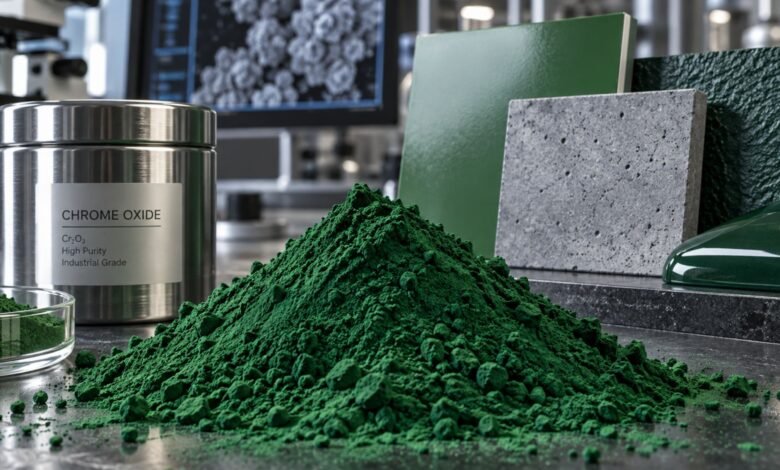
Searches for Chromtex currently produce a strange mixture of explanations. Some pages describe a textile-processing system, others frame it as advanced fabric technology, while the strongest current manufacturer evidence points to a very different product: CHROMTEX™ synthetic chrome oxide green pigments sold by Polish pigment specialist ZWUKSO.
That distinction matters because the word is also easily confused with Chromatex Chemicals Pvt. Ltd., a Pakistan-based producer of textile auxiliary chemicals. Chromatex is a separate spelling and a separate business identity. ZWUKSO’s own documentation does not describe CHROMTEX™ as a textile technology; it describes it as a chrome oxide green pigment series for industrial colouring.
BLUF: What is Chromtex?
CHROMTEX™ is a ZWUKSO product series of finely milled synthetic chrome oxide green pigments based on chromium(III) oxide, Cr₂O₃. It is used to colour paints, plastics, concrete, bricks, tiles, rubber, flooring, enamel frits and coloured glass, and should not be confused with Chromatex textile chemicals or treated as a universal textile technology.
The documented CHROMTEX identity is a pigment, not a fabric
The clearest primary-source evidence comes directly from ZWUKSO, a Polish company specialising in inorganic pigments.
ZWUKSO identifies CHROMTEX™ as a chrome oxide green series. The manufacturer describes the material as a very finely milled synthetic pigment based on Cr₂O₃, or chromium(III) oxide, with strong colouring power, high hiding power and good dispersibility.
That description places CHROMTEX firmly inside industrial colour formulation.
It is not presented as a finished consumer product. Instead, it is an ingredient incorporated into another material so that the final product acquires a stable green appearance and the desired pigment-performance characteristics.
Chromtex at a glance
- Documented product name: CHROMTEX™
- Manufacturer: ZWUKSO Sp. z o.o. Sp.k.
- Manufacturer location: Siemianowice Śląskie, Poland
- Product type: Synthetic inorganic pigment
- Colour: Chrome oxide green
- Chemical basis: Chromium(III) oxide, Cr₂O₃
- CAS number for Cr₂O₃: 1308-38-9
- Primary documented use: Industrial colouring
- Listed grades: GA-U, GA-R, GN, GA, GA-3, GA-6, GA-40 and GA-60
- Listed packaging: 25 kg bags and 1,000 kg big-bags
The manufacturer’s broader company information says ZWUKSO was founded in 1989 and operates primarily in the inorganic-pigment trade, including titanium dioxide, iron oxide and chrome oxide green.
Why the name keeps getting pulled into the textile industry
The biggest source of confusion is probably not chemistry at all. It is spelling.
Chromtex and Chromatex differ by only one letter, but they can lead to substantially different subjects.
Chromatex Chemicals Pvt. Ltd. says it has served the textile industry since 1999 and manufactures auxiliary chemicals for textile pretreatment, dyeing and finishing. Its product portfolio includes antifoams, enzymes, hydrogen peroxide stabilisers, sequestering agents, wetting agents, detergents, anti-creasing products, levelling agents, dye-fixing agents, softeners and other textile-processing chemicals.
That company has a genuine and direct connection with textiles.
It does not, however, establish that CHROMTEX™ is the name of a textile technology.
A searcher who types “chromtex textile” may therefore encounter pages that have taken the better-known textile association of Chromatex and applied it to the shorter spelling Chromtex. The result is a plausible-sounding explanation that is difficult to reconcile with the current CHROMTEX™ manufacturer record.
The distinction can be summarised simply:
| Search term | Documented identity | Main sector |
|---|---|---|
| CHROMTEX™ | ZWUKSO chrome oxide green pigment series | Paints, plastics, construction materials and related industrial products |
| Chromatex Chemicals Pvt. Ltd. | Textile auxiliary chemical manufacturer | Textile pretreatment, dyeing and finishing |
| Chromium(III) oxide / Cr₂O₃ | Chemical compound used as an inorganic pigment and in other industrial applications | Chemistry, materials and manufacturing |
ZWUKSO’s product page does not list textile processing among the principal applications of its CHROMTEX™ pigment series.
The chemistry behind the green: Cr₂O₃ in plain English
The material underlying CHROMTEX™ is chromium(III) oxide, written chemically as Cr₂O₃.
The International Chemical Safety Cards prepared under the ILO and WHO identify chromium(III) oxide by CAS number 1308-38-9 and EC number 215-160-9. The substance is described as a light-to-dark-green powder with a molecular mass of approximately 152, a melting point of 2,435°C, a boiling point of about 4,000°C, a density of 5.22 g/cm³, and no solubility in water.
PubChem also identifies chromium(III) oxide as Cr₂O₃, lists the CAS number 1308-38-9 and records the substance under names including chromium(III) oxide, chromia and chromic oxide.
The chemistry explains why the substance is valuable to pigment manufacturers.
A pigment has to do more than provide colour. Industrial formulations may expose it to heat, weather, mechanical processing, binders, solvents or alkaline construction materials. The pigment therefore needs appropriate stability and dispersibility for the specific formulation.
That is why CHROMTEX™ exists as a range of grades rather than one universal powder.
Eight CHROMTEX grades are listed by the manufacturer
ZWUKSO’s current English product page names:
- CHROMTEX GA-U
- CHROMTEX GA-R
- CHROMTEX GN
- CHROMTEX GA
- CHROMTEX GA-3
- CHROMTEX GA-6
- CHROMTEX GA-40
- CHROMTEX GA-60
The manufacturer’s page also presents technical-data and safety-data document columns for these grades. That is a useful signal for industrial buyers: the correct grade should be identified before ordering rather than assuming every CHROMTEX product has identical performance characteristics.
Where CHROMTEX™ is actually used
ZWUKSO’s application list is unusually broad, but it is also specific.
The manufacturer says CHROMTEX™ can be used for pigmenting:
- paints
- plastics
- primers
- ground paints
- fillers
- coloured facade mixtures
- synthetic facade mixtures
- concrete roofing
- coloured bricks
- tiles
- rubber products
- flooring
- enamel frits
- coloured glass
Those applications make sense when viewed as a materials problem.
A green pigment used in a decorative paint does not necessarily face the same processing conditions as a pigment incorporated into plastics or concrete. A pigment destined for coloured glass may encounter high temperatures that are irrelevant to an interior wall coating.
The practical question is therefore not simply “Is Chromtex green?”
It is:
Which CHROMTEX grade is specified for the material, formulation and production process?
That is the more useful industrial question.
Paints and architectural coatings
Paint is one of the most straightforward applications.
Here, the pigment becomes part of the coating system and contributes colour and opacity. ZWUKSO specifically cites paints, primers, ground paints, fillers and facade mixtures.
High hiding power is particularly relevant where manufacturers want a relatively effective colour contribution without requiring excessive pigment loading.
Concrete, bricks and roofing materials
CHROMTEX™ is also positioned for construction materials.
ZWUKSO identifies concrete roof tiles, coloured bricks, tiles and facade mixtures among its uses.
In these applications, the pigment becomes part of a mineral-based or cementitious product rather than a conventional liquid coating. The manufacturing process, dosage, cement chemistry and required shade can all influence the appropriate product grade.
Plastics and rubber
Colouring plastics and rubber creates another set of technical demands.
The pigment must be compatible with the polymer or elastomer system and retain the desired colour through processing. ZWUKSO lists both plastics and rubber products among the documented applications.
The page does not claim that every grade is interchangeable between these uses. That is another reason to rely on the individual technical data sheet.
Glass and enamel frits
Coloured glass and enamel frits represent a more specialised use.
These processes may involve considerably higher temperatures than conventional paint manufacturing. Chromium(III) oxide’s high melting point helps explain why chrome oxide pigments have long been relevant to high-temperature colour applications. The ILO-WHO safety card records a melting point of approximately 2,435°C.
The important qualification is that a substance’s melting point alone does not determine how it behaves in every industrial formulation. Batch composition, particle characteristics, processing atmosphere and the surrounding material all matter.
The safety question requires chemistry, not a shortcut
The word chromium often triggers immediate concern because chromium compounds do not all have the same toxicological profile.
That distinction is scientifically important.
CHROMTEX™ is described by ZWUKSO as Cr₂O₃, chromium(III) oxide.
That should not be casually treated as equivalent to chromium(VI) compounds such as chromium trioxide or dichromates. ECHA lists chromium trioxide separately as a substance subject to stringent regulatory controls, including carcinogenic and mutagenic classifications.
At the same time, calling chromium(III) oxide “safe” without qualification would be equally misleading.
The ILO-WHO International Chemical Safety Card states that airborne particles can reach harmful concentrations quickly when the material is dispersed. It identifies potential mechanical irritation of the eyes and respiratory tract, with cough listed as a possible symptom following inhalation. Its preventive guidance includes dust control, local exhaust or suitable respiratory protection, gloves and eye protection.
That is the practical industrial lesson:
The pigment’s hazard profile has to be assessed in its actual powder form, workplace conditions and intended process.
Dust generation matters.
Handling matters.
Ventilation matters.
And the specific supplier’s safety data sheet remains the correct document for operational controls.
Cr₂O₃ should not be confused with chromium(VI)
| Chemical | Formula | Chromium oxidation state | Relationship to CHROMTEX™ |
|---|---|---|---|
| Chromium(III) oxide | Cr₂O₃ | +3 | Material identified by ZWUKSO for CHROMTEX™ |
| Chromium trioxide | CrO₃ | +6 | Different substance with separate regulatory profile |
| Sodium dichromate | Na₂Cr₂O₇ | +6 | Different chromium compound |
| Potassium dichromate | K₂Cr₂O₇ | +6 | Different chromium compound |
ECHA identifies chromium trioxide, sodium dichromate and potassium dichromate separately within European chemical regulation.
What CHROMTEX™ does not prove about “smart textiles”
A recurring online claim describes Chromtex as though it were a single next-generation fabric platform capable of improving strength, softness, durability, colour retention or smart-fabric functionality.
The current manufacturer evidence does not support that broad definition.
ZWUKSO describes CHROMTEX™ as a synthetic chrome oxide green pigment series. Its named applications are industrial colouring uses involving coatings, plastics, construction materials, rubber, flooring, enamel and glass.
That does not mean advanced textile chemistry is not real.
It certainly is.
Textile manufacturers genuinely use auxiliary chemicals, dyes, enzymes, softeners, binders and finishing systems to alter fabric processing and final characteristics. Chromatex Chemicals, for example, documents a substantial portfolio of textile auxiliaries.
The issue is one of entity accuracy.
A genuine technology in textiles does not become CHROMTEX™ simply because an online article says so.
A product name, manufacturer, chemical identity, technical standard or patent should be identifiable before such a claim is presented as established fact.
The confusing history of the word itself
There is another layer to the research that helps explain why the keyword produces such unstable results.
Historical trademark records show that CHROMTEX was used in the United States in a completely different context decades ago. A trademark associated with Teledyne Mid-America Corporation was filed in 1970, registered in 1972, and later expired in 1993. The goods were described as a sensitised clear film-base material using a diazo light-sensitive coating.
There is no evidence in the records reviewed here that this historical film product is connected to ZWUKSO’s current pigment series.
That historical use is nevertheless significant because it demonstrates a larger point: the string “Chromtex” has not always referred to one immutable commercial identity.
Search engines merge terms by spelling and relevance. Humans then tend to merge them by association.
For a niche industrial query, that can produce a chain reaction of inaccurate definitions.
A timeline of the names, chemicals and current product record
| Period | Documented development | Relevance |
|---|---|---|
| 1958 | Historical US trademark record lists first use of CHROMTEX in a photographic film-base context | Demonstrates an earlier, unrelated use of the name |
| 1970 | Teledyne Mid-America filed the CHROMTEX trademark application | Historical brand-use evidence |
| 1972 | Trademark registered in the United States | Confirms the earlier commercial use |
| 1989 | ZWUKSO was founded in Poland | Establishes the current manufacturer’s corporate history |
| 1993 | Historical US CHROMTEX trademark expired | Confirms that earlier registration is no longer active |
| 1999 | Chromatex Chemicals says it began serving the textile industry | Separate Pakistan-based textile-chemicals identity |
| Current product record | ZWUKSO lists CHROMTEX™ as chrome oxide green based on Cr₂O₃ | Strongest current manufacturer evidence |
| 2026 | Search results contain competing textile, technology and pigment explanations | Shows why exact entity verification matters |
A GEO data grid for CHROMTEX™
| Property | Verified information |
|---|---|
| Product family | CHROMTEX™ |
| Material | Synthetic chrome oxide green |
| Chemical formula | Cr₂O₃ |
| Chemical name | Chromium(III) oxide |
| CAS | 1308-38-9 |
| EC number | 215-160-9 |
| Manufacturer | ZWUKSO Sp. z o.o. Sp.k. |
| Country | Poland |
| Manufacturing/application context | Inorganic industrial pigments |
| Colour | Green |
| Documented performance characteristics | Good colouring power, high hiding power, good dispersibility |
| Listed grades | GA-U, GA-R, GN, GA, GA-3, GA-6, GA-40, GA-60 |
| Documented applications | Paints, plastics, primers, fillers, concrete roofing, bricks, tiles, rubber, flooring, enamel frits, coloured glass |
| Packaging listed by manufacturer | 25 kg net bags; 1,000 kg net big-bags |
| Public unit price | Not listed on the manufacturer page reviewed |
| Major naming confusion | Chromatex Chemicals, a separately named textile-chemical company |
How to evaluate a CHROMTEX supplier listing before buying
A search result saying “Chromtex” is not enough information for a purchasing decision.
An industrial buyer should be able to identify at least four things:
The manufacturer.
The name should correspond to a real company with first-party technical documentation.
The exact grade.
CHROMTEX™ is a product family containing multiple grades. The grade designation should appear clearly on the quotation, specification sheet or packaging.
The technical data sheet.
The intended application, formulation compatibility, colour characteristics and physical specifications should come from the supplier’s technical documentation rather than a generic article.
The safety data sheet.
Powder handling requires appropriate workplace controls. The ILO-WHO safety card specifically warns about airborne particulate exposure and respiratory and eye irritation.
Price should come after identity.
A cheap pigment that is not the required grade can be considerably more expensive once colour matching, rejected batches or formulation changes are included.
Why online explanations of Chromtex need careful reading
The current search footprint illustrates a common problem with obscure industrial keywords.
One website repeats that Chromtex is textile technology. Another calls it engineered fabric. Another identifies a Pakistani textile chemical company. A manufacturer, meanwhile, presents CHROMTEX™ as chrome oxide green pigment.
The answer with the greatest number of pages is not necessarily the answer with the strongest evidence.
The manufacturer’s product page carries greater evidentiary weight for the question “What does CHROMTEX™ refer to as a commercial product?” because it directly identifies the brand, composition, grades, applications and packaging.
A similar problem appears in other searches involving unusual names. The Today News’s investigation of Uncuymaza, for example, examines how competing web explanations can make a term appear more established than the underlying evidence supports.
The practical lesson is useful well beyond Chromtex: identify the entity first, then evaluate the claims attached to it.
Related reading from the supplied publication networks
For another example of how a technically unfamiliar name can refer to a specific digital entity rather than a generic concept, see Enntal, the AI-first software agency profile on Global Nova. Enntal: AI-first software agency and business automation profile
These links are editorially related to the verification problem surrounding unfamiliar search terms rather than being presented as technical sources for CHROMTEX™.
Frequently Asked Questions About Chromtex
What is Chromtex?
Chromtex, in the strongest current commercial documentation, refers to CHROMTEX™, a ZWUKSO series of synthetic chrome oxide green pigments based on chromium(III) oxide, Cr₂O₃. The manufacturer lists applications across paints, plastics, concrete, bricks, tiles, rubber, flooring, enamel frits and coloured glass.
Is Chromtex a textile technology?
CHROMTEX™ is not identified by its current manufacturer as a general textile technology. The documented product is a chrome oxide green pigment. Textile-related search results may instead be referring to Chromatex Chemicals Pvt. Ltd., a separate Pakistan-based manufacturer of auxiliary chemicals for textile pretreatment, dyeing and finishing.
What is CHROMTEX™ made from?
CHROMTEX™ is based on synthetic chromium(III) oxide, Cr₂O₃. ZWUKSO describes its product as finely milled chrome oxide green. The underlying chemical is identified by CAS number 1308-38-9 and EC number 215-160-9 in international chemical-safety documentation.
What is CHROMTEX™ used for?
CHROMTEX™ is used as an industrial green pigment. ZWUKSO lists paints, plastics, primers, ground paints, fillers, facade mixtures, concrete roofing, coloured bricks, tiles, rubber products, flooring, enamel frits and coloured glass among its applications. The correct grade depends on the formulation and production process.
How many CHROMTEX™ grades are there?
ZWUKSO currently lists eight CHROMTEX™ grades: GA-U, GA-R, GN, GA, GA-3, GA-6, GA-40 and GA-60. The manufacturer’s product page provides technical-data and safety-data sections associated with the series, so industrial buyers should identify the exact grade rather than treating the entire family as technically identical.
Is chromium(III) oxide the same as chromium(VI)?
No. Chromium(III) oxide, Cr₂O₃, and chromium(VI) compounds are chemically distinct substances with different properties and regulatory profiles. The ILO-WHO safety card identifies Cr₂O₃ separately, while ECHA separately regulates substances such as chromium trioxide and dichromates. Chemical identity should therefore be checked before making safety assumptions based only on the word “chromium.”
The evidence points to a much narrower answer than the internet suggests
Chromtex is not best understood as a mysterious universal textile invention.
The strongest current evidence gives it a much clearer identity.
CHROMTEX™ is a commercial range of synthetic chrome oxide green pigments from ZWUKSO, built around chromium(III) oxide, Cr₂O₃. The manufacturer documents its use in coatings, plastics, construction materials, rubber, flooring, enamel frits and coloured glass, with eight named grades and industrial packaging options.
The confusion comes from several directions: the similar spelling of Chromatex, unrelated historical uses of the word CHROMTEX, and recent online articles that assign broader technological meanings without identifying a matching manufacturer, product specification or standard.
For anyone researching, sourcing or writing about the term, the safest route is therefore precise:
CHROMTEX™ → ZWUKSO → chrome oxide green → Cr₂O₃ → industrial pigment.
Chromatex → separate Pakistan-based textile-chemical company.
That distinction turns a vague search query into a verifiable industrial identity.
Editorial Disclaimer: This article treats CHROMTEX™ as the current product identity documented by ZWUKSO and distinguishes it from similarly spelled businesses, chemical substances and historical trademarks. Product specifications can vary by grade and formulation. Industrial users should consult the current manufacturer technical data sheet and safety data sheet before use. Information reflects sources reviewed as of 21 September 2026.